

Why Identity-Based Habits Last Longer Than Goal-Based Ones
Imagine two people who want to quit smoking. One says, "I'm trying to quit." The other says, "I'm not a smoker." On the surface, both are working toward the same goal. But research in behavioural psychology suggests the second person is far more likely to succeed — not because of greater willpower, but because of a deeper shift in identity.
Most self-improvement advice focuses on what you want to achieve. Set a goal. Track your progress. Stay motivated. And yet, statistics on New Year's resolutions tell a different story: roughly 80% fail by February. The goals themselves aren't the problem. The approach is.
This post explores why identity-based habits last longer than goal-based ones, what the psychology tells us about how lasting behaviour change actually works, and how you can make a practical shift that sticks.

The Core Difference: Goals vs. Identity
Goal-based habits are outcome-focused. You want to lose 10 kg, run a marathon, or read 24 books this year. There's nothing inherently wrong with having targets. The issue is what happens once you reach them — or don't.
Identity-based habits, a concept popularised by James Clear in Atomic Habits, start one layer deeper. Instead of asking "What do I want?" you ask "Who do I want to become?" The goal isn't to run a marathon — it's to become the kind of person who runs. The goal isn't to write a book — it's to become a writer.
This shift matters because your habits are essentially votes for your identity. Every time you lace up your running shoes, you're casting a vote for the person who exercises. Every time you sit down to write, even for ten minutes, you're reinforcing the belief that you are a writer. Over time, those votes accumulate into a self-concept that makes the behaviour feel natural, not forced.
Key Takeaway
Goal-based habits ask: What do I want to achieve? Identity-based habits ask: Who am I becoming? The second question creates habits that feel like expressions of self rather than acts of discipline.
Why Goal-Based Habits Often Fail
The Arrival Fallacy
When you build a habit purely around a goal, you're setting up what psychologist Tal Ben-Shahar calls the arrival fallacy — the belief that you'll feel satisfied once you reach the destination. But after the marathon is run, the weight is lost, or the book is finished, many people feel a surprising emptiness. Without the identity to sustain the behaviour, the habit dissolves.
This connects to a broader pattern explored in Why We Choose Comfort Even When Growth Matters More: once the external pressure of a goal is removed, our brains default back to familiar patterns.
Motivation Is a Shaky Foundation
Goal-based habits often rely on motivation as their engine — and motivation, as science shows, is deeply unreliable. It fluctuates with mood, sleep, stress, and circumstance. The research on behavioural consistency strongly suggests that motivation follows action, not the other way around. You can read more on this in Why Motivation Follows Action: The Science Behind Getting Started.
When motivation is your primary fuel, you're one bad week away from abandoning everything. But when your habit is tied to identity, you don't rely on feeling motivated — you act because it's who you are.
The Finish-Line Problem
Goal-based habits also have an inherent endpoint. Once you've lost the weight, read the book, or hit the sales number, the system that was supporting the behaviour disappears. Identity-based habits, by contrast, have no finish line — because becoming someone never stops.
Real-Life Example
Sarah joined a gym with the goal of losing 15 pounds before her wedding. She worked hard, hit her target, and then — over the following six months — gradually stopped going. Marcus, on the other hand, began thinking of himself as someone who moves his body every day. Three years later, he still exercises regularly, even though he never set a specific fitness goal.
The Psychology Behind Identity-Based Habit Formation
Cognitive Consistency and the Self-Concept
Human beings are wired to act in ways that are consistent with their self-concept. When a behaviour aligns with how we see ourselves, it feels effortless. When it conflicts with our identity, it creates psychological friction. This is why telling yourself "I am someone who doesn't skip workouts" is more powerful than telling yourself "I want to be fit."
Psychologists refer to this as cognitive consistency — our deep-seated drive to think, feel, and behave in ways that match our internal narrative. When the habit becomes part of the narrative, it becomes self-reinforcing.
The Role of Small Wins
Identity doesn't form in a single breakthrough moment. It accumulates through small, repeated actions — what researchers call "micro-habits" or "keystone behaviours." Each consistent action is evidence that you are the person you believe yourself to be.
This is why How to Build Habits That Stick (Science-Backed Guide 2026) emphasises starting with the smallest possible version of a behaviour. A two-minute meditation doesn't just build a mindfulness habit — it builds evidence that you are someone who meditates.
Habit Loops and Identity Anchoring
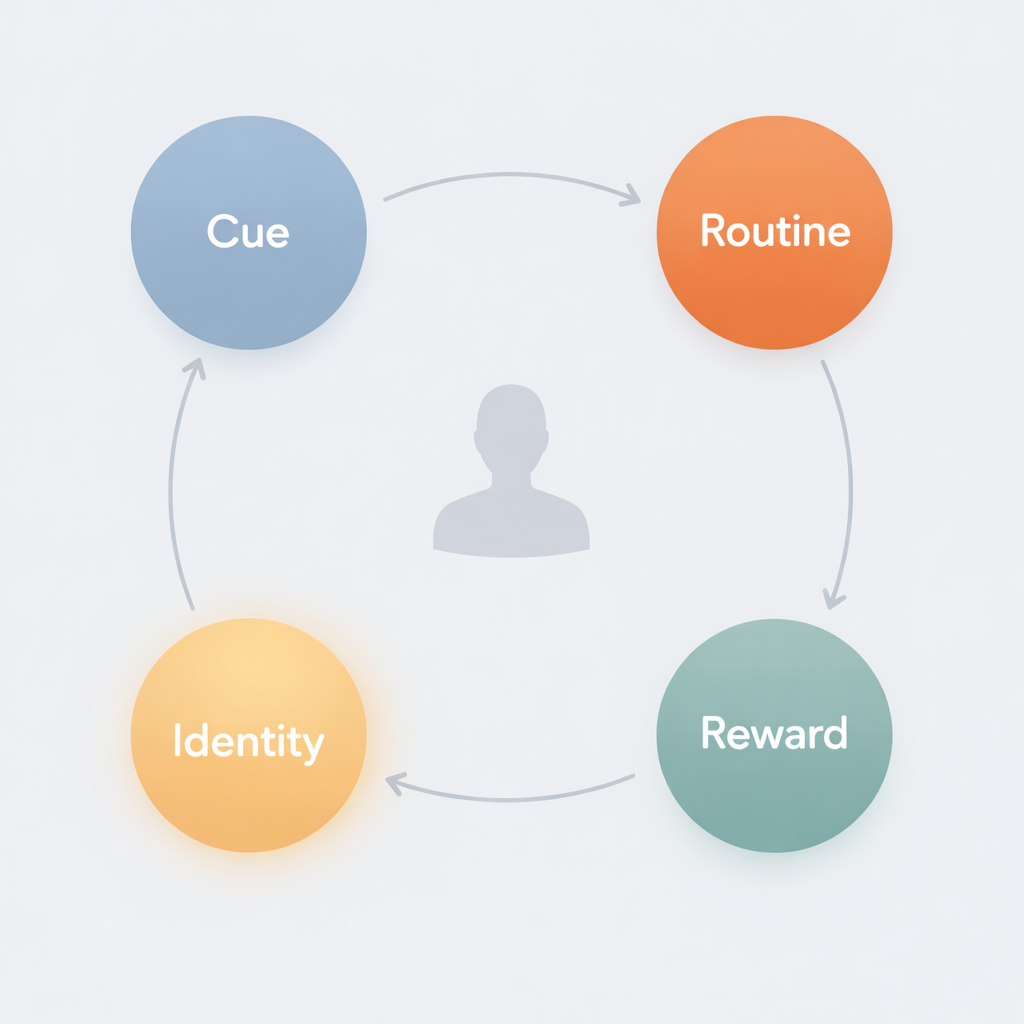
Neuroscience tells us that habits form through a loop: cue, routine, reward. Identity anchoring adds a fourth element: meaning. When the routine is tied to a sense of self, the reward isn't just external (feeling relaxed, sleeping better) — it's internal. Performing the habit becomes its own confirmation that you are the person you want to be. For a deeper look at why bad habits are so hard to break, see Why Bad Habits Become Hard to Break & How to Overcome Them.
How to Shift from Goal-Based to Identity-Based Habits
Step 1: Define the Type of Person You Want to Be
Rather than writing down your goals, write down the kind of person who naturally achieves them. If you want financial stability, ask: what does a financially responsible person do daily? If you want deeper relationships, ask: what does someone with rich social connections prioritise?
This shift in framing reduces the cognitive load associated with willpower. As The Psychology of a Happy Life: How Your Mind Shapes Everyday Joy explores, people who feel aligned with their values and identity tend to report higher life satisfaction — often regardless of whether they've achieved specific external goals.
Step 2: Cast Small Votes Consistently
You don't need to transform overnight. Identity is built through consistency, not intensity. Commit to the smallest, most sustainable version of your desired habit and perform it every day. Even on difficult days, do a reduced version — this matters enormously for the integrity of your identity.
Research suggests that even a token effort — five minutes of writing, a single push-up, one mindful breath — maintains the identity thread. You can explore the broader psychology of why starting small matters in How to Overcome Procrastination Scientifically: 7 Proven Methods (2026 Guide).
Step 3: Use Language That Reflects Your Identity
The words you use to describe yourself matter. When offered a cigarette, don't say "I'm trying to quit" — say "I don't smoke." When someone asks why you exercise, don't say "I'm trying to get fit" — say "It's just part of my routine." Language signals identity to yourself as much as to others.
Step 4: Surround Yourself With People Who Share the Identity
Social identity is a powerful force. When the people around you embody the habits you want to develop, those habits become the norm rather than the exception. Research suggests social environment is one of the most underrated predictors of long-term behaviour change.
Understanding how your environment and relationships shape your habits connects directly to the findings in Nudge Theory in Everyday Life: 10 Ways It Shapes Your Decisions, which explores how subtle environmental cues can make good behaviours feel automatic.
A Word on Setbacks
Every person who has built a lasting identity-based habit has also broken it temporarily. Missing a day doesn't destroy your identity — it's a normal part of the process. The critical difference is how you interpret the lapse.
Goal-based thinkers often interpret one missed session as evidence that they've failed. Identity-based thinkers interpret the same event as an anomaly — "That wasn't me." They dust off and return to the behaviour because the behaviour is an expression of who they are, not a measure of whether they've succeeded.
This connects deeply to the psychology of self-compassion and how we interpret failure. Many people catastrophise missed habits in the same way they catastrophise other setbacks — a pattern explored in Why Do I Overthink Everything, Even When Nothing's Wrong?.
Remember
Missing once is an accident. Missing twice is the start of a new habit. The goal is never perfection — it's returning to your identity after every deviation.
Frequently Asked Questions
Can you have both goals and identity-based habits?
Absolutely. Goals can serve as useful direction-setters — they tell you where to go. But identity is the fuel that sustains the journey. The most effective approach uses goals as initial direction while shifting the focus to identity for long-term consistency.
How long does it take to form an identity-based habit?
Research suggests it takes anywhere from 18 to 254 days to form a new habit, with the average around 66 days — far longer than the popular "21-day" myth. Building an identity-based habit may take longer initially, but it produces far more durable behaviour once established.
What if my identity and my goals conflict?
This is more common than people realise. Someone who sees themselves as a busy, productive professional may struggle to build a meditation habit — because stillness conflicts with their identity. In these cases, it helps to reframe: "High performers protect their mental clarity with daily mindfulness." The habit doesn't change — the identity framing does.
Conclusion
Goals give you a destination. Identity gives you a reason to keep walking even when the destination isn't in sight. The science of behaviour change is increasingly clear: identity-based habits outlast goal-based ones because they tap into something far more durable than motivation — your sense of self.
When you begin to define yourself by your habits rather than your outcomes, something shifts. The behaviour stops feeling like discipline and starts feeling like self-expression. You don't exercise because you should — you exercise because that's what people like you do.
Start small. Cast consistent votes. Use language that reflects who you're becoming. And if you're curious about what else gets in the way of lasting change, exploring The Fresh Start Effect: Why New Beginnings Make Change Actually Stick is a worthy next step.


