

The Moment You Stopped Trying (And Didn't Notice)
There's a job you hate but haven't applied anywhere else in three years.
A relationship pattern you complain about but never address.
A health issue you've accepted as permanent without getting a second opinion.
When someone suggests you could change these things, you have immediate responses:
"You don't understand—it's complicated."
"I've tried before. It doesn't work for people like me."
"That's just how my life is."
You're not being pessimistic. You're being realistic. Right?
Here's the uncomfortable possibility: You've stopped trying so completely that you don't even recognize options when they appear. Your brain has learned that effort doesn't matter, so it's stopped generating effort. You've developed what psychologists call "learned helplessness"—and it's operating in the background of your life without your conscious awareness.
The terrifying part isn't that you feel helpless. It's that you don't feel helpless—you feel realistic. You've internalized powerlessness so deeply that it doesn't register as a problem anymore. It registers as fact.
The Original Experiment That Revealed Everything
What Seligman Actually Found
In 1967, psychologist Martin Seligman accidentally stumbled onto one of the most important discoveries in behavioral psychology.
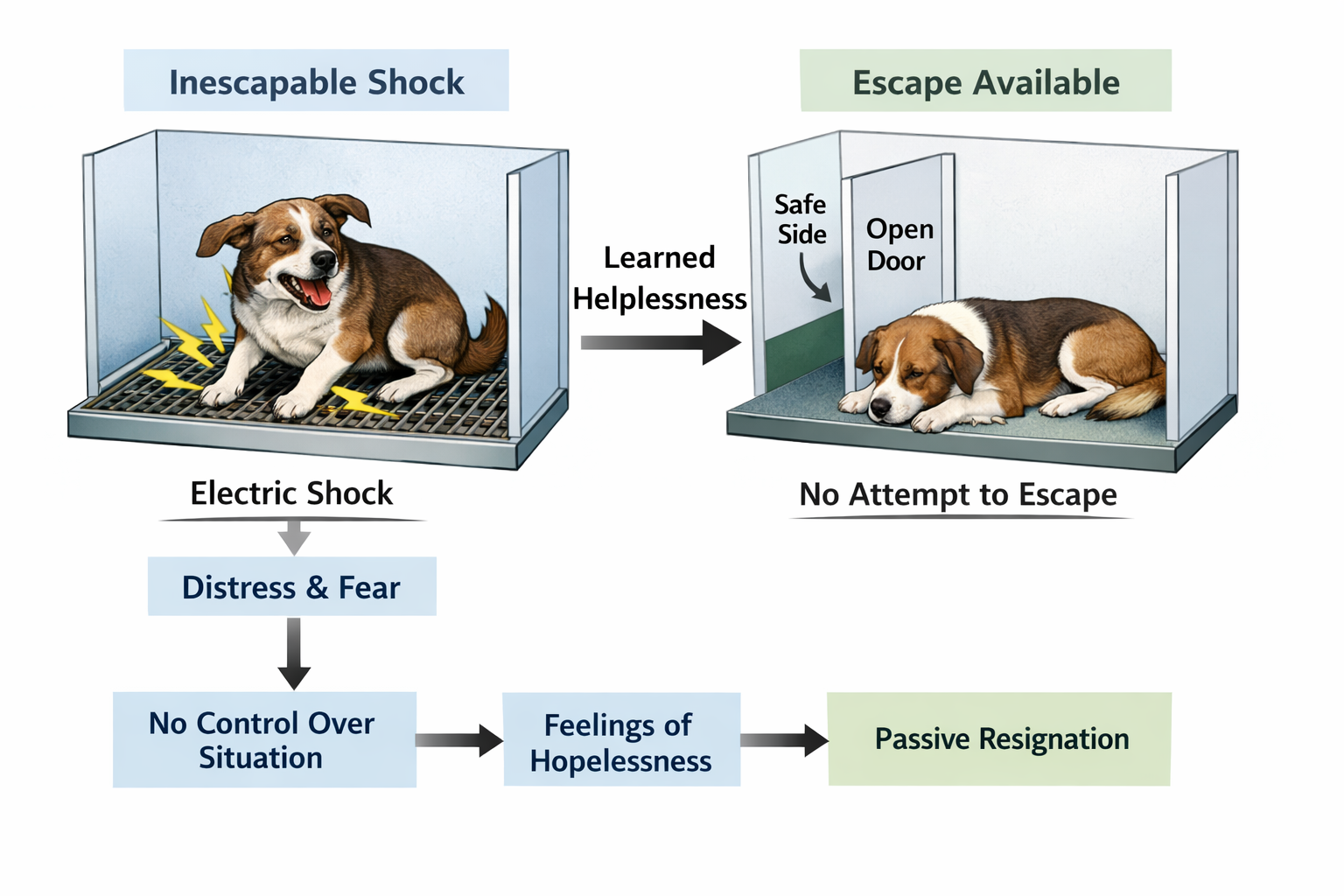
He was studying classical conditioning with dogs. The experimental setup: dogs would hear a tone, then receive a mild electric shock. The dogs could escape the shock by jumping over a low barrier to the other side of the chamber.
Normal dogs learned quickly. Hear tone. Jump barrier. Avoid shock.
But Seligman had a separate group of dogs who had previously been exposed to inescapable shocks—shocks they couldn't avoid no matter what they did.
When these dogs were placed in the new chamber where escape was possible, something disturbing happened:
They didn't even try to escape.
The barrier was low. The exit was obvious. Escape was completely possible. But the dogs who had previously experienced inescapable shock just lay down and accepted the pain.
They had learned that their actions didn't matter. Even when circumstances changed and control became available, they couldn't see it. The helplessness had become their reality.
The Disturbing Human Parallel
Seligman's next question: Does this happen to humans?
The answer, confirmed through decades of research across thousands of studies, is yes—and it's probably more common than we want to believe.
Humans who experience repeated situations where their efforts don't produce results—abusive relationships, poverty, discrimination, chronic illness, toxic workplaces, invalidating families—can develop the same pattern.
They stop trying.
Not because they're weak or lazy. Because their brain has created a predictive model: effort = no change. So the brain stops generating effort. It's being efficient, not defeatist.
The mechanism is the same whether you're a dog receiving shocks or a human in a situation where your agency has been repeatedly undermined.
But here's what makes it insidious in humans: we can talk ourselves into believing this is wisdom, not helplessness.
"I'm just being realistic."
"I know my limitations."
"Some things can't be changed."
Sometimes that's true. But sometimes it's learned helplessness disguised as maturity.
What Learned Helplessness Actually Looks Like in Your Life
Learned helplessness doesn't announce itself. It masquerades as acceptance, realism, or self-knowledge.
In Your Career
You've been in the same role for eight years. Underpaid. Undervalued. When friends suggest looking elsewhere, you have a script:
"The job market is terrible."
"I don't have the right experience."
"Companies don't want people my age."
"I tried applying before and never heard back."
You might be right about market conditions. Or you might have sent out five applications three years ago, got rejected, and internalized that as proof that all future attempts would fail.
The learned helplessness shows up as: not keeping your resume updated, not networking, not learning new skills, not even browsing job listings—because what's the point?
You've stopped trying so thoroughly that you don't recognize it as giving up. You think you're being realistic about your options.
In Your Relationships
You're consistently attracted to emotionally unavailable people. Your friends point this out. You agree, and then date another emotionally unavailable person.
Or: You're unhappy in your current relationship but haven't had a direct conversation about your needs in two years.
Or: You've wanted to make new friends but haven't initiated plans with anyone in months.
When pressed, you say: "That's just my type" or "We don't communicate well" or "I'm not good at making friends."
These statements feel true. But they're not describing fixed reality—they're describing learned helplessness around relationships. You tried before. It didn't work. So you stopped trying in ways that feel like identity ("I'm not good at...") rather than behavior.
In Your Health
You have chronic pain, low energy, digestive issues, or persistent symptoms. You saw a few doctors who dismissed you or couldn't find anything. So you stopped looking for answers.
Or you know you should exercise, eat better, or address that concerning symptom, but you've "tried before and it didn't stick," so now you don't try at all.
The learned helplessness sounds like: "Doctors don't take me seriously anyway" or "My body just doesn't respond to exercise" or "I've always been this way."
You've generalized from specific failures to universal impossibility.
In Your Finances
You're living paycheck to paycheck. When someone suggests budgeting or side income, you have reasons why it won't work for you specifically.
"I've tried budgeting. I'm bad with money."
"I don't have skills people would pay for."
"I'm already working all the time."
These might be real constraints. Or they might be learned helplessness after a few failed attempts convinced you that you fundamentally can't improve your financial situation.
The pattern: you stopped exploring options because previous exploration didn't immediately solve the problem, so your brain concluded exploration itself is futile.
The Three Components That Lock You In
Seligman identified three core elements that characterize learned helplessness:
Perceived Lack of Control
You believe that outcomes are independent of your actions.
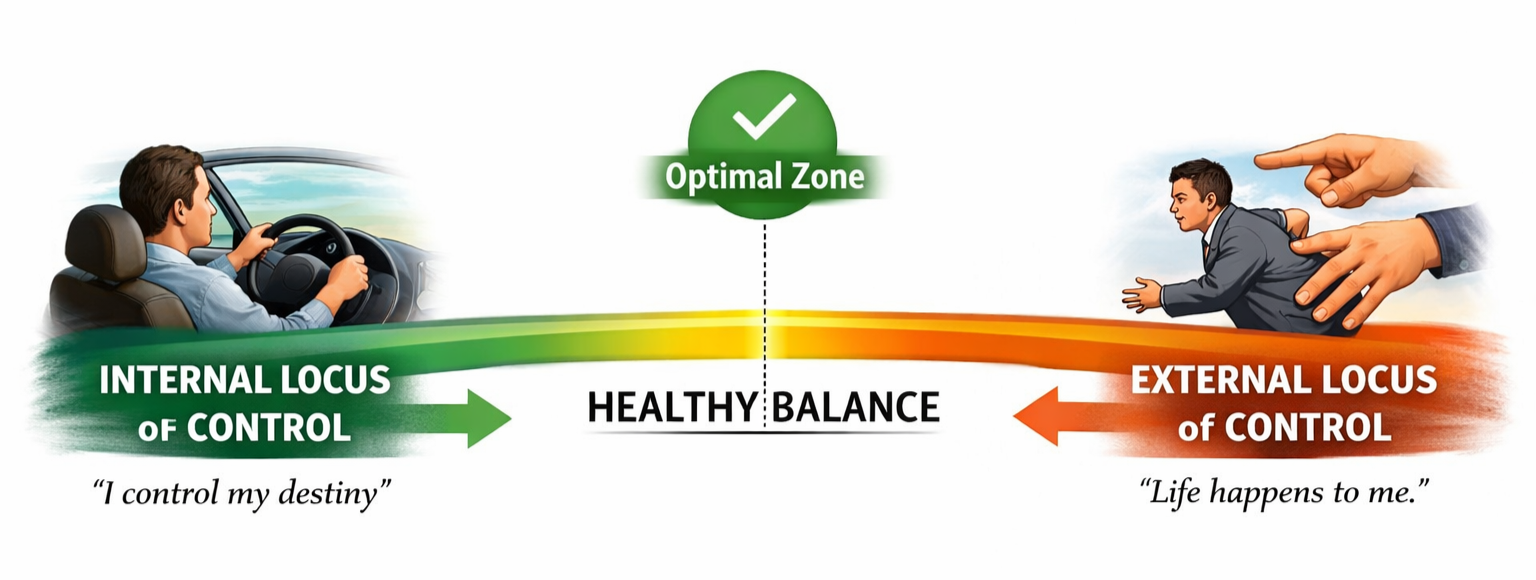
In psychology terms: you have an external locus of control. Things happen to you, not because of you.
This isn't always wrong—many things genuinely are outside your control. But learned helplessness extends this beyond reality. It convinces you that even controllable things aren't controllable.
Reality: "I can't control whether I get this specific job."
Learned helplessness: "I can't control anything about my career trajectory."
The second statement treats all career outcomes as equally uncontrollable, which isn't true—but it feels true when you've stopped trying.
Passive Acceptance
Instead of attempting to change circumstances, you endure them.
You don't actively choose helplessness. But you've stopped generating solutions. When problems arise, you tolerate them rather than problem-solve.
This looks like:
- Waiting for situations to change on their own
- Hoping someone else will fix it
- Complaining without acting
- Accepting explanations that maintain the status quo
The passivity feels like patience or acceptance. But it's actually the absence of agency.
Attributional Style
This is how you explain why bad things happen.
Seligman's research on explanatory style found that helpless people explain negative events as:
Personal: "It's my fault" (not circumstantial)
Permanent: "It will always be this way" (not temporary)
Pervasive: "Everything in my life is like this" (not specific)
Example: You apply for three jobs and get rejected.
Healthy attribution: "Those particular positions weren't the right fit. I'll adjust my approach and keep applying." (Specific, temporary, external factors considered)
Helpless attribution: "I'm unemployable. I'll never get hired anywhere. I'm a failure." (Personal, permanent, pervasive)
The second attribution style doesn't just feel worse—it actively prevents further attempts.
How It Develops Without You Knowing
Learned helplessness doesn't require dramatic trauma. It builds gradually through specific experiences.
Repeated Failure Despite Effort
You tried hard. Multiple times. Genuine effort. No results.
Your brain's job is pattern recognition. If it sees: effort → failure, effort → failure, effort → failure... it learns the pattern. Effort doesn't predict success, so stop wasting energy on effort.
This is why people who grew up in poverty often struggle to believe effort leads to success—their lived experience taught them otherwise. It's why people in abusive relationships stop trying to communicate—past attempts at communication led to punishment, not resolution.
The learning is accurate to your past. The problem is your brain assumes the future will be identical.
Unpredictable or Uncontrollable Punishment
When negative consequences come regardless of what you do, your brain stops trying to control them.
If you get yelled at whether you do the task perfectly or poorly, why try for perfect? If your parent's mood swings are random, why try to manage their mood? If layoffs seem arbitrary, why work hard to prove your value?
Research shows that unpredictability is more psychologically damaging than consistent negative outcomes. At least with consistency, you can adapt. With randomness, you learn that adaptation is pointless.
Invalidation of Your Experiences
When your reality is repeatedly dismissed, you stop trusting your own perception and agency.
"You're too sensitive."
"It's not that bad."
"Other people manage fine."
"You're making excuses."
Over time, you internalize: My assessment of situations is wrong. My feelings don't reflect reality. I can't trust myself to know what needs to change or how to change it.
This is particularly damaging in childhood but continues in adult relationships, workplaces, and even medical settings where people's reported experiences are dismissed.
Chronic Stress and Trauma
Extended periods of high stress without relief or control deplete the neurological resources needed for agency.
Your prefrontal cortex (planning, decision-making, agency) goes offline. Your amygdala (threat detection) takes over. You're stuck in survival mode where the goal is just getting through, not changing anything.
Research on trauma shows that chronic activation of stress response systems rewires the brain toward helplessness. It's not a choice—it's a neurobiological adaptation to prolonged overwhelm.
The Invisible Thoughts That Maintain It
Learned helplessness operates through specific thought patterns you might not even notice.
"Nothing I Do Matters Anyway"
This is the core belief. Effort and outcome are disconnected in your mind.
You might not say this explicitly, but you can see it in behavior:
- Not voting because "my vote won't change anything"
- Not applying for opportunities because "they won't pick me anyway"
- Not expressing needs because "it won't make a difference"
Each time you don't try, you reinforce the belief. The lack of trying guarantees the outcome you predicted, which your brain logs as confirmation.
"This Is Just How Things Are"
Acceptance is sometimes healthy. But learned helplessness disguises itself as acceptance.
Healthy acceptance: "I can't change this specific thing, so I'll focus energy elsewhere."
Learned helplessness: "Everything is unchangeable, so I'll focus energy nowhere."
The second version treats your entire life as fixed when only parts of it actually are.
"Other People Can Change, But Not Me"
You can see agency in others' lives while being blind to it in your own.
You believe your friend could leave their bad job, but you can't leave yours. You think your sibling could improve their health, but you're stuck with your symptoms. You see others building businesses, relationships, skills—but those paths aren't available to you specifically.
This selective helplessness often stems from identity-level beliefs: "I'm the type of person who..." or "People like me don't..."
The identity becomes the cage.
Why Your Brain Prefers Helplessness to Hope
Here's the paradox: learned helplessness is psychologically protective, even as it's objectively harmful.
Hope requires vulnerability. If you believe change is possible, you might try. If you try, you might fail. If you fail, you'll feel pain.
Helplessness is safer. If you believe nothing will work, you don't have to try. If you don't try, you can't fail at trying. You're protected from disappointment.
Your brain doesn't optimize for thriving. It optimizes for minimizing anticipated pain.
Learned helplessness becomes a psychological insurance policy against hope. As long as you don't hope, you won't be crushed when hope doesn't pan out.
Researcher Brené Brown calls this "foreboding joy"—the inability to let yourself feel hope or happiness without immediately imagining disaster. Learned helplessness is the behavioral version: the inability to attempt change without immediately predicting failure.
Your brain thinks it's protecting you. But it's actually imprisoning you.

Breaking Free: How to Reclaim Agency
Learned helplessness can be unlearned. But it requires specific, intentional practices—not just "thinking positive."
Start With Tiny Controllable Experiences
You can't immediately convince your brain that effort matters by tackling big problems. You need micro-successes.
Find the smallest possible area where cause and effect still work:
- You water a plant, it grows (control over living thing)
- You clean one surface, it stays clean (control over environment)
- You message a friend, they respond (control over social connection)
- You complete a small task, you check it off (control over achievement)
These aren't life-changing wins. They're evidence that actions produce results. Your brain needs that evidence before it will invest in bigger attempts.
Research on behavioral activation (treatment for depression) uses exactly this approach: start with tiny controllable actions to rebuild the belief that effort matters.
Challenge Your Explanatory Style
When something goes wrong, notice how you explain it.
Your automatic thought: "I failed the interview. I'm terrible at interviews. I'll never get hired."
Challenge it:
- Personal → Consider external factors: "The interviewer seemed distracted. They might have already had a preferred candidate."
- Permanent → Make it temporary: "I struggled with this particular interview style. I can practice for different formats."
- Pervasive → Make it specific: "This interview didn't go well. That doesn't mean all interviews will fail."
You're not being delusional. You're being accurate. Most setbacks are specific, temporary, and partly circumstantial—but learned helplessness makes you interpret them as personal, permanent, and pervasive.
Gather Evidence Against Helplessness
Your brain has years of data supporting helplessness. You need to collect counterevidence.
Keep a log (written, not mental—mental logs have bias):
- Times your effort led to positive outcomes (even small ones)
- Situations you influenced even partially
- Problems you solved
- Decisions that mattered
After two weeks, you'll have concrete evidence that agency exists in your life. This isn't toxic positivity—it's data collection to counteract cognitive distortion.
Reintroduce Small Risks
Learned helplessness makes you avoid any action that could lead to disappointment. To break it, you need to practice tolerating that possibility.
Start with low-stakes risks:
- Apply to one opportunity expecting rejection (practice: effort without guaranteed outcome)
- Try one new approach to an old problem (practice: experimentation)
- Ask one small favor (practice: influence)
- State one preference (practice: agency in relationships)
The goal isn't success. The goal is relearning that attempting things is survivable even when they don't work out.
When Professional Help Becomes Necessary
If learned helplessness has been operating for years, self-help approaches might not be enough.
See a therapist if:
- You recognize the pattern but can't generate any action to change it
- The helplessness extends across all life domains
- It's accompanied by depression, trauma symptoms, or suicidal thoughts
- You've tried the strategies here for 2-3 months without any shift
Effective therapeutic approaches include:
- Cognitive Behavioral Therapy (CBT) for changing explanatory style
- Behavioral Activation for rebuilding agency through action
- EMDR or trauma therapy if helplessness stems from past trauma
- Sometimes medication to address underlying depression that maintains helplessness
Learned helplessness isn't a character flaw. It's a psychological adaptation that made sense given your experiences. But adaptations that once protected you can become prisons. You're allowed to outgrow them—even if your brain insists you can't.
The dogs in Seligman's experiment who learned helplessness? They could be retrained. It took patience and repeated experiences of successful escape, but they eventually learned that their actions mattered again.
You're not a lab dog. But the principle holds: helplessness is learned, which means it can be unlearned. The first step is recognizing it's there—which you're doing right now by reading this. The second step is one small action that proves, even slightly, that effort can matter.
What's one thing—genuinely just one small thing—you've stopped trying that you could try again?
Not because it will definitely work. But because trying itself is how you teach your brain that agency still exists.


